20 April 2006

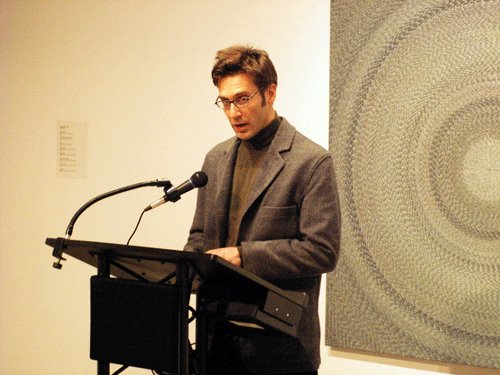
Featured Poet: David Pavelich


David Pavelich lives in Chicago, where he works at the University of Chicago as a special collections librarian and bibliographer for contemporary and modern poetry.

He edits and publishes Answer Tag chapbooks and broadsides in limited editions. His poems have appeared or are forthcoming in Antennae, Aufgabe, Bird Dog, LVNG, and other journals, and prose has appeared or is forthcoming in Chattahoochee Review, Crayon, and The Progressive Librarian. Chapbooks of his poems have been published by Cuneiform Press and Bronze Skull Press.


WEST

for Jesse Seldess


This could be the way
of the building back,

without size
the early line

pulled back to the copper
neighborhood.

Open a corner.
The world of air,

the children’s field,
a wall of insulation

without size.
Lift up your distance –

this could be the way
of the building forward,

this could be a kind of
made wood.


THE DANDELION COPY


An emphasis of stripes is
a simple machine.

Equal is light blue
into the pocket,

the picture of
the viceroy.

We are all healed up
after all,

three times removed.
The still to live,

the wind, the awning,
the roots of our cuttings.

This one, a moving cloud,
is already a sketch of rain.


“FOR THE MOMENT WE CAN’T SEE THE FACES”


Numbers into shuttle
makes the message:

and when it was done
it was done.

Of the thousands,
a grasshopper.

Of the couple in tandem
a grasshopper.

There are more affordances
for a fold on the grain,

that these threads
might not be broken.

Sand in the struggle,
in height, in forward,

the grain joins the stream.
And when it was done,

the thousands.


NOONS

Maybe because
they were simple
the gray areas
of the pull
cut across
some rainbow –
of reaching
the back reveals
the braid that you carry
is another weave
of constraint


NATURAL BRIDGE [Previously appeared in Bird Dog]


Some barn
astronomy,

that the same model,
same hopefulness

grows stronger.
A three-cornered barn

leans into the lawn, is lawn –
grows a lawn of barnlight,

summerblue.
Only give it circles

and given back around
surround the sycamore.

05 April 2006

Featured Poet: Gabriel Gudding


Gabriel Gudding is the author of two books, A Defense of Poetry (Pitt Poetry Series,2002) and rhode island notebook (Dalkey Archive Press, 2008), the latter being a book he wrote entirely in his car during 25 roundtrips on the highways between Providence, RI and Normal, IL. The book is a mixed-genre work chronicling the play of sorrow in the driver’s life and a nation’s march to war. A resident of Normal, Illinois since 2002, he teaches Literature and Creative Writing at Illinois State University. He is a trained mediator for the university and practices Vipassana meditation in the tradition of Sayagyi U Ba Khin. His work appears in such venues as New American Writing, LIT, Fence, American Poetry Review, Sentence, Jacket, and in such anthologies as Great American Prose Poems: From Poe to the Present (Scribner, 2003). He serves on the Board of Directors for the internationalist magazine _Mandorla: New Writing from the Americans/ Nueva Escritura de las Américas_. He has begun two creative writing programs in prisons and maintains a blog, Conchology. And oh yeah: "Gudding" rhymes with pudding.


MINNESOTA [first appeared in NEW AMERICAN WRITING]


And without your brief umbrella
when I was wild
I was young, and the lakes I had been to
and the lake I had been in
were petrol blue in the evening
and stray smells of straw were on them

and nearby the maple docks
the attention of the carnivores
was bound in the gooses

all these living things
on the lake home
when I was a child, I was
wild upon it, the tennis court by the lake
strange how the animals
enjoyed their wings

some of the small live things were swollen
others tiny, some were windy

there was a squirrel who was windy
none had umbrellas
and for a while when I was 12
my parents did love the lakes, and all of us
and themselves


NO, POPSICKLE [first appeared in Court Green]

for Kerry Mahan Griner


No, popsickle: stay.
Don’t be eaten. Remain in the freezer, the
super market, lodge in the long
far-traveling fridge truck—Be convoyed: indeed
be conveyed for a Dakota
a Missouri—but when the truck arrive
at its depository
—or store—at the end of what hot bridge in the dim forenoon,
stay, little bulb of colored cold,
far in your cozy no-no.
I say chill, be a child, popsickle, refuse.


AN DITCH [first appeared in LIT]


They have leftht uth a lone at latht
There are logth and thtarth to thtub our toeth and catch too at our eyeth:
Thith ditch ith gloriouth.

Look at them! The night’s jars, the thtrange daubing wellth of light:
You over me then like a thtar!, our legth twining
below our grointh.
Your deep fish. My hand-ache. My handth walk
into the China of your boobieth.

Making love in thith ditch
ith gloriouth!


BILLY COLLINS


The small beads of grease
riding the soup-sheen
are all I have.

I would suck them up
and forget the soup.
They are orange as kerosene

as if they spilled from a farm house
deep in the soup.
Maybe I will put my eye down
close to the grease waves
and try to see the fields

and the distant churchyard
in the chicken noodle.

I will wave to the farm girl
waiting for her mama, and think
what a lank silo of seed

will meet her
in those fields.


DEAR EAGLES [first appeared in The Canary]


I am bored by beagles those happy dogs
so indelibly at gates. They’re unlike
the nation’s eagles who bang on gelid gusts
above our fields and shining logs. I am
not, thus, bored by yóu—all
your pleasures gentried, such epaulets
and fuss—and never over are the clawed towings
of fish with your angled feathers, no: Dó call me
an eagle lover, then. You are possibles.

Yet too you that once that were some symbols
of this nation that dealt some blows: you are not now
—nor are you ever always will be again—
ethicals,

your country’s over. And though you’re here still,
you will surely go.

For I have seen few snowmen outlast the snows.

Sincerely,

Gabriel Gudding


LITERARY NARCISSISM AND THE MANUFACTURE OF SCANDAL

1. A Literary Narcissist’s behavior will not only tolerate but encourage attacks on himself so long as it can translate his own self-fascination into more news of himself.

2. Just as the Narcissist will use argument, catastrophe, disputation to attract attention, certain people will be willing to dispute the Narcissist in order to participate in the economy of attention. Others will dispute the Narcissist because they are so profoundly appalled by his/her behavior. Either way, the economy of attention is fueled.

3. The Narcissist needs Catastrophe. The more internal crises of shame the Narcissist endures and fails to heed, the more s/he will need to create external Catastrophes. A chief and signal way a Narcissist might attract attention is to start fights: Narcissists will gravitate toward satire and caricature as a means of creating argument. The Narcissist will attempt to construe strife with health: These arguments need to happen, etc.

4. The Narcissist IS fascinating -- but not for the reasons the Narcissist thinks. S/he is fascinating because the energy s/he will expend in micromanaging the self image is so profoundly exceptional. People just sort of stand there slack-jawed wondering if this person has a life. The Narcissist however will mistranslate the fascination of others as admiration.

5. Poetry communities will tolerate narcissism so long as it is translated into a Social Energy which others can use to strengthen and promote their projects.

6. Narcissism and alcoholism. Alcoholism is a systematic way to push down socially regulating emotions like shame, guilt, and embarrassment at ones own self-aggrandizing behavior. The suppression of these emotions is never successful, even in the most energetic of self-aggrandizers, and they will periodically burst upward into brief displays of remorse and convictions to change. These brief spouts of regulatory behavior are sometimes shared publicly and sometimes privately among confidants. These displays however can often easily be re-used by the Narcissist as a way of showing his/her authenticity and emotional fealty to the community.

7. The Narcissist is aware of the economy of disgust surrounding his/her behavior. S/he becomes more and more sensitive to this and consequently begins to demand private declarations of loyalty from those people whom s/he knows consider themselves friends -- even if they have said nothing publicly against the Narcissist.

8. The Narcissist, aware of this disgust, will create a personal mythos in which s/he will be justified and exonerated by the rewards of literary history. The stronger the disgust of others, the greater the energy used to maintain the mythos of exoneration by history.

9. Narcissists are only interested in community so long as it pays dividends to their energy: they will support it if it feeds them.

10. The narcissist may outright demand in private that you pay him publicly with praise. Then he or she will publicly repay you with a communal mention.

11. In their attempt to cause others to adopt their self-fascination, Narcissists will become increasingly paranoiac, constantly searching the environment and community for news of themselves, for fealty or disloyalty.

12. The Literary Narcissist begins purposefully to conflate criticism of his social behavior into an indication of his/her literary worth. That is to say, the Narcissist will try to show that the reason others despise or are disgusted by him is in fact because he or she is a Rebel, a true Literary Revolutionist -- and that the statements of disgust others publicly make at his behavior is merely an indication of (a) their necessary denial of the work because they are threatened by it, or (b) their jealousy of the work.

13. There comes a point -- and the point may come early -- where the community thinks to itself teapot and the Narcissist still hears tempest. The truly insular narcissist (aka "the boor") will be met more and more with shunning, ignoring and silence. This will wrest the narcissist from his insularity -- such that he will begin another project designed to create Genuine Interest instead of mere scandalous attention. This project, like a new comet's head, will be followed by a long tail of manufactured scandal so as to call attention to its presence in the literary sky.


Copyright  © Gabriel Gudding

22 March 2006

Featured Poet: Garin Cycholl

Garin Cycholl teaches writing and literature at the University of Illinois at Chicago, where he also works as co-editor of Near South, a journal of experimental poetry, fiction, and drama. His recent work will appear this spring with Admit2 and Keep Going. He is author of Nightbirds (moria books 2006), and Blue Mound to 161, a book-length poem on geological and historical displacements in Southern Illinois (Pavement Saw Press 2005).


AM

nostalgia is his-
t’ry eating itself—
contortions for
the camera’s ear,
the boys down
the hall singing,

America’s a
dead horse an
abandoned drive-
in an auto parts
store with dusty
inventory a hot
dog stand with
a silent partner

he worries—
he thinks, I’m
a fat man in a
tight suit he
says into his
lapel, “another
five years of
fucking plan”

modulation—not
a direct line, but
one that winds
through place


they said that series was fixed

“and if they hadn’t
known his head be-
fore, they certainly
did when it rolled
out of the piñata”


Three poems for Rita Figueroa


“two by knockout”

1
your hands are two bags
of Quikrete, loose
money and clenched
rags sing
it! we
live in a
slow time, you
said ring the
bell and


2
toe to toes curled
and cinched against
knuckle negative
Aphrodite three
steps down a
rope “oh, to
be with my baby
down in Nelson
Algren’s fuck
shack,” you
sang bones
in the corner


3
a loose jaw gathers
no what? five
bucks against
that I
would like to
be called Caesar,
get off the bus
at Western light
my pipe with
fifty-dollar
bills watch
Grant’s head
explode in
blue flame


Song for Meriwether Lewis

dead by his own hand (probably)

Farewell, old knife, now that you’ve come home! I’ve stabbed plenty. Farewell my Boise, my Tennessee. My mashed potatoes. Where’s that old dog? Crime does not simply happen. Like a triangle, crime must have three sides or elements to be complete. Ability, desire, and opportunity. Farewell, my fingers, frozen to my belt and axe. The horses I’ve eaten. Farewell to the samples collected along rivers, in emptied streambeds. Farewell, serious lieutenants, dead in the snow. You can say you found me dead on this picnic table, jaw full of bison. Bulbs plucked and eaten raw. Call security immediately. A man gave me some good advice once. He said, “Take the camera out of your ass, son. We’ve got to snap some pictures of these cliffs.” But now it’s farewell. Farewell, my Mobridge, my Platte. Indian girl pulling her hair loose in rough strands. Where’s that old dog? Ability, desire, opportunity. Remove any one of these elements and the triangle can't be formed and the crime will not occur. The boys already upriver, wondering how many more steps that horse’ll take. Clark and I left to dreams of eating chicken from a cardboard tub by the interstate. Farewell, to you, too, f-stop, silver baths, and things that go “click.” The gray waters of Astoria piled against the sky. Where’s that old dog? Call security immediately. Campfires and whiskey rebellions. Pocket pistols and Improvised Philadelphia. Farewell, opportunity. Farewell, desire. Farewell, ability. Farewell, old knife, stuck firmly in my back!

08 March 2006

Featured Poet: Kristy Bowen


Kristy Bowen’s work has appeared or is forthcoming in Diagram, Milk Magazine, Swink, Rhino, and Another Chicago Magazine. She is the author of a number of handmade chapbooks, which are available at her website, as well as a full length book, the fever almanac, due out from Ghost Road Press this fall. She edits the electronic zine, wicked alice and runs dancing girl press, which publishes work by women poets. Be sure to check out her blog, too.

Editor's Note: Kristy Bowen and fellow Seven Corners alum Kristy Odelius will be reading at Myopic Books book on Sunday, March 19. Don't miss it.


erythrophobia

Sometimes, it was all red. The dash light, my dress, the fire alarm of my mouth. Even my hair makes a sound like that now. Before you know it, I’m the patron saint of disaster. Of car crashes and open hydrants. The vowels gone round and sloppy in my mouth as candy. For luck, I carry three tiny vermillion birds in the bottom of my purse. A cross in the crux of my crimson bra. In the furnace of my lungs, sometimes there’s a hissing, a swirl, like a sink emptying. I am careful not to riot.


girls against boys

When she makes an o of her mouth,
the forsythia behind her head bursts into flame.
Singes clotheslines full of blue gingham
pinafores and yellow flowered sheets.
When she bends at the waist, she can make an o
of her body. A birdcall. A tiny pink sequin.
Can make up names for the baby teeth
beneath her dresser. Lydia. Amelia.
Their tiny lion tin. Can define the pinwheel
of her arms falling through dark.

The trellis by the steps slicks in the rain
and all night he calls for his extra rib,
his good heart’s hinge. Sad, sad.
No one can sleep with it. The world
is all checked cotton and charm bracelets now.
I can move my mouth in a whisper.
Could give you the instructions,
if we found the proper word.


from the hysteria notebooks: a gothic
I. Catherine, for a moment, was motionless with horror.

Our story indicates the parlor door
remain closed, the lace at her wrist
worn, and slightly rent. Granted,
there are bones in the body science

hasn’t even discovered yet: this,
the one at her throat that tightens
when the white dress takes flight
from the window, or the slivers
in the ear discerning motion.

A woman in the corner is counting spools
of thread while a man in a black coat watches.

The light falls to ruin.


He had then proceeded to throw suspicion upon the girl, saying that he had heard from Frau K. that she took no interest in any other thing but sexual matters, and that she used to read Mantegazza’s Physiology of Love and books of that sort in their house on the lake. It was most likely, he had added, that she had been over excited by such reading and had merely “fancied” the whole scene she had described.

I. Attitudes Passionelles


When he touched her, violets on her tongue,
and afterward, in the folds of her bed linen.

Landscape plays a greater role than one would think.

The dark moors, the moon. How can we but forgive this girl,
dear reader; her dresses unravel us. Or him, his penchant
for the distraught. Now, we are moving

through dark rooms, the rustle of skirts, held breath.
Something must have been here in the moments before,
the thread that, alas, saves us dissappearing round the corner.


II. Rest Cure


Hippocrates first proposed that hysteria was caused by a wandering uterus. He believed that the uterus could dislodge itself in the body and wander around the female body attaching itself to other organs. He explained that the various symptoms of hysteria, such as nervousness, depression, and hysterical fits were caused by the uterus’s interactions with the other organs in the body.


You see, the woman in the attic is nothing

more than the axis on which our heroine turns—

countryside, silver locket, cover of snow.

A bread knife has more to do with it than how

many saints she could name in one breath.

Here, an illustration.

Take away the books. The sharpened point
of a compass, its circle widening. We are apt
to fear the body, the sentences scrawled beneath
the teacup’s pale lip. Each tendon a wire,
jumping at the proximity of silks.

The villain is you father. The villain is your doctor..
The villian is your mother, ten years gone
and wearing white. Once they’ve taken
away the paintbox, you can stop pretending.

Those darling, fragile reds.

Poet's note: “from the hysteria notebooks: a gothic” is from the errata series, my chapbook of Victorian genre-bending pieces.


02 March 2006

Featured Poet: Michael O'Leary

Michael O'Leary is the founding editor of LVNG magazine and the co-director of Flood Editions. He is currently pursuing a Ph.D. in fracture mechanics at the University of Illinois at Chicago.

ONE DAY
for Stephanie Tipton

In the morning of the last day
of summer when the air is sharp
with coolish winds from Canada
and swallows dip along the hedge
at sinusoidal intervals
abandoning the last pliant tips
of little bluestem for the pale
vectors of nowhere, you know
it is not the laminar flow
of their vanishing nor their smooth
bellies that makes them beautiful.
Noon is now and the afternoon
a temptation, an afterthought
of pure abstraction, albeit
Jesuitic. But evening comes
like a stately lawn where a great
silver ball gently rolls to a stop.
In time the hollyhocks grow long,
in time the sunflower is beaten
down by the heat of its own
colossus and the last blossom
of the day is all but subsumed
by the supple granulation
of a very ancient wound.


THE CHILLS

The street quite still.
Down the long corridor

a light, several doors
and a single pine.

Conversations on
the wires are quiet,

sequestered from here
to there, ear to ear.

The most intimate
jokes get lost sometimes,

even simple questions
go unanswered.

Quiet's like that.
Magnificent crystals

of ice spider
across the creaking panes.


FALLS OF THE OHIO

It was calm like bedtime
with water falling off the dam
in tiny castellations.

Flakes of limestone lay about
the base of massive piers raising
the truss above the river.

Water thunders from the turbine.
Two trash pickers sift through driftwood
for a lucky find.

And high above the sluice
a sparrow swoops down to catch
a fleck of dirty water

before resuming his little song
among the stalks of marshgrass dried
and split like last year's palms.


Copyright © 2006 Michael O'Leary